
Organizations don’t have a benefit utilization problem. They have a visibility problem.
Every year, companies invest significant dollars into employee benefits: health plans, mental health support, wellness programs, family resources, financial tools, EAPs–the list goes on and on. The intent is clear and well-meaning: support employees, improve outcomes and reduce long-term costs. Yet engagement in these programs remains stubbornly low–not because employees do not care or because the programs lack value, but because, for most employees, those benefits are effectively invisible.
Offering great benefits doesn’t automatically lead to impact
HR teams often measure success by what’s offered. But employees experience benefits very differently. They measure them by:
- What they remember in the moment (often limited to the busy open enrollment season)
- What feels relevant to their life right now
- What’s easy to access without friction or confusion
If a benefit doesn’t meet those criteria, it doesn’t get used. And if it doesn’t get used, it doesn’t deliver value–no matter how strong it looks in a deck or enrollment guide.
The real gap: translation, not investment
Most organizations don’t need to add more benefits, and you’ve already spent a lot of time building the right offering for your employees. You need a better way to connect employees to what already exists.
Right now, benefits are typically presented as a list during the busy open enrollment season, each with its own language, branding and touchpoints
- Health plan
- EAP
- Wellness platform
- Family support
- Behavioral health
- Financial tools
- Weight loss programs
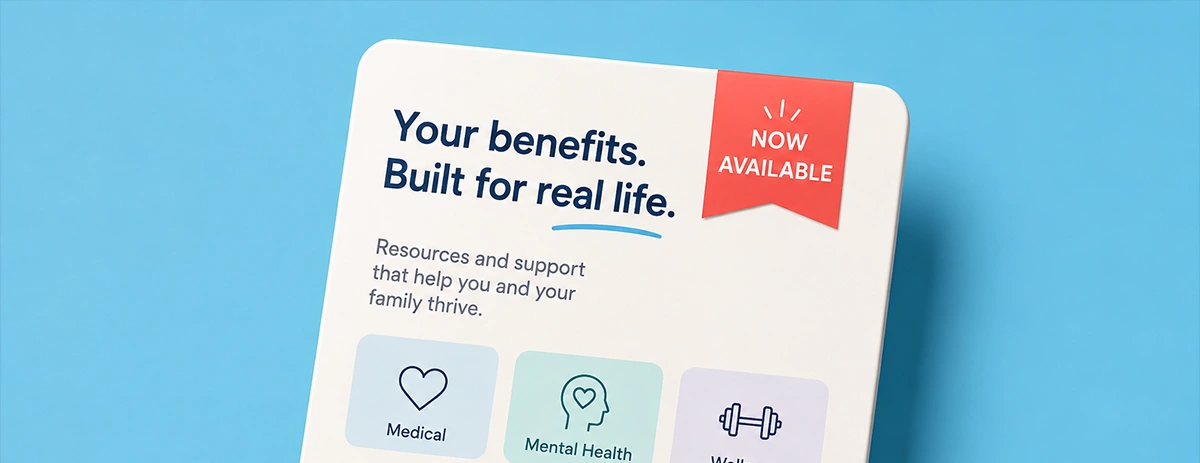
To employees, it’s fragmented and complicated, and it’s easy to ignore and hard to navigate. A branded benefits approach changes that.
What happens when benefits become a system
When benefits are unified under a clear, consistent brand and marketing communication strategy, something shifts:
- Employees recognize and remember what’s available
- Messaging through tactics like emails, on-site activations and intranet presence connects to real-life moments throughout the year, not just enrollment windows
- Calls to action are timely, simple and specific
- Engagement extends beyond healthcare into everyday wellbeing
Instead of occasional spikes in awareness, you get sustained behavior change. And that’s where the real return shows up:
- Increased utilization of existing programs
- Improved employee health and wellbeing
- Stronger perception of total rewards
- Better alignment between investment and impact
- Healthier employees
This isn’t about better marketing. It’s about better outcomes.
Branded benefits aren’t a marketing gimmick. It’s a way to operationalize your investment so employees don’t just have access to support, they actually know about it and use it.
The reality is: You’ve already paid for the benefits. The question is whether employees will ever fully realize their value?
How to move from fragmented benefits to a benefits brand
If this sounds familiar–low engagement, disconnected programs, confused employees–it might be worth a conversation. The good news is that you aren’t starting from scratch. Developing a benefits brand and a communications strategy to support utilization is the easy part.
Visit our landing page for more info on how this works, and brands we’ve helped. If you’d rather talk it through, we’re always open to a no-pressure working session.
Sometimes it just takes a different lens to see what’s already there.